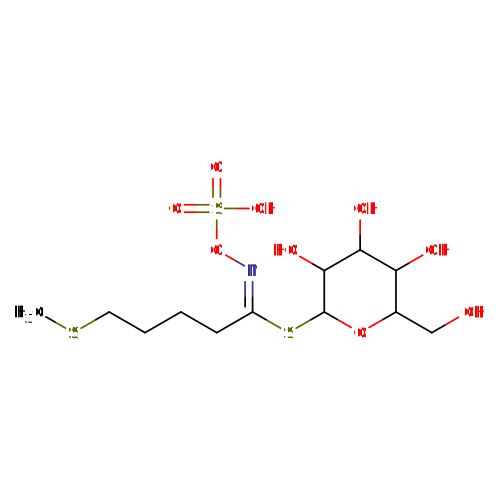
| Record Information |
|---|
| Version | 2.0 |
|---|
| Created at | 2022-03-17 21:07:02 UTC |
|---|
| Updated at | 2022-03-17 21:07:02 UTC |
|---|
| NP-MRD ID | NP0049094 |
|---|
| Secondary Accession Numbers | None |
|---|
| Natural Product Identification |
|---|
| Common Name | Glucoerucin |
|---|
| Description | Glucoerucin belongs to the class of organic compounds known as alkylglucosinolates. These are organic compounds containing a glucosinolate moiety that carries an alkyl chain. Glucoerucin is an extremely weak basic (essentially neutral) compound (based on its pKa). Outside of the human body, Glucoerucin has been detected, but not quantified in, several different foods, such as cabbages, chinese cabbages, white cabbages, brassicas, and common cabbages. Glucoerucin is found in Alyssoides utriculata, Alyssum argenteum, Alyssum chondrogynum, Alyssum tortuosum, Arabidopsis thaliana, Aurinia saxatilis, Brassica oleracea var. napobrassica , Brassica sprouts, Cakile constricta, Cakile edentula, Cakile geniculata, Cakile lanceolata, Cakile maritima , Camelina sativa , Capsella bursa-pastoris , Cardaria chalapensis, Carrichtera annua, Chorispora tenella, Diplotaxis erucoides , Diplotaxis griffithii, Diplotaxis tenuifolia , Diplotaxis viminea, Draba aizoides, Eruca longirostris, Eruca vesicaria, Erysimum allionii, Erysimum cheiranthoides, Cheiranthus cheiri , Erysimum hieracifolium, Erysimum perofskianum, Erysimum repandum, Farsetia clypeata, Farsetia jacquemontii , Farsetia ramosissima, Hesperis matronalis , Iberis amara , Iberis sempervirens, Lepidium draba , Lepidium iberis, Lepidium perfoliatum, Lesquerella engelmannii, Lesquerella globosa, Matthiola bicornis, Matthiola fruticulosa, Physaria angustifolia, Pringlea antiscorbutica, Thelypodium crispum, Thelypodium eucosmum and Thelypodium laciniatum. This could make glucoerucin a potential biomarker for the consumption of these foods. |
|---|
| Structure | CSCCCC\C(SC1OC(CO)C(O)C(O)C1O)=N/OS(O)(=O)=O InChI=1S/C12H23NO9S3/c1-23-5-3-2-4-8(13-22-25(18,19)20)24-12-11(17)10(16)9(15)7(6-14)21-12/h7,9-12,14-17H,2-6H2,1H3,(H,18,19,20)/b13-8+ |
|---|
| Synonyms | | Value | Source |
|---|
| 1-Thio-b-D-glucopyranose 1-[5-(methylthio)-N-(sulfooxy)pentanimidate], 9ci | HMDB | | 4-Methylthiobutyl glucosinolate | HMDB | | {[(e)-[5-(methylsulfanyl)-1-{[3,4,5-trihydroxy-6-(hydroxymethyl)oxan-2-yl]sulfanyl}pentylidene]amino]oxy}sulfonate | Generator | | {[(e)-[5-(methylsulphanyl)-1-{[3,4,5-trihydroxy-6-(hydroxymethyl)oxan-2-yl]sulphanyl}pentylidene]amino]oxy}sulphonate | Generator | | {[(e)-[5-(methylsulphanyl)-1-{[3,4,5-trihydroxy-6-(hydroxymethyl)oxan-2-yl]sulphanyl}pentylidene]amino]oxy}sulphonic acid | Generator | | Glucoerucin | MeSH |
|
|---|
| Chemical Formula | C12H23NO9S3 |
|---|
| Average Mass | 421.5070 Da |
|---|
| Monoisotopic Mass | 421.05349 Da |
|---|
| IUPAC Name | {[(E)-[5-(methylsulfanyl)-1-{[3,4,5-trihydroxy-6-(hydroxymethyl)oxan-2-yl]sulfanyl}pentylidene]amino]oxy}sulfonic acid |
|---|
| Traditional Name | [(E)-[5-(methylsulfanyl)-1-{[3,4,5-trihydroxy-6-(hydroxymethyl)oxan-2-yl]sulfanyl}pentylidene]amino]oxysulfonic acid |
|---|
| CAS Registry Number | 21973-56-8 |
|---|
| SMILES | CSCCCC\C(SC1OC(CO)C(O)C(O)C1O)=N/OS(O)(=O)=O |
|---|
| InChI Identifier | InChI=1S/C12H23NO9S3/c1-23-5-3-2-4-8(13-22-25(18,19)20)24-12-11(17)10(16)9(15)7(6-14)21-12/h7,9-12,14-17H,2-6H2,1H3,(H,18,19,20)/b13-8+ |
|---|
| InChI Key | GKUMMDFLKGFCKH-MDWZMJQESA-N |
|---|
| Experimental Spectra |
|---|
|
| Not Available | | Predicted Spectra |
|---|
|
| Not Available | | Chemical Shift Submissions |
|---|
|
| Not Available | | Species |
|---|
| Species of Origin | |
|---|
| Chemical Taxonomy |
|---|
| Description | Belongs to the class of organic compounds known as alkylglucosinolates. These are organic compounds containing a glucosinolate moiety that carries an alkyl chain. |
|---|
| Kingdom | Organic compounds |
|---|
| Super Class | Organic oxygen compounds |
|---|
| Class | Organooxygen compounds |
|---|
| Sub Class | Carbohydrates and carbohydrate conjugates |
|---|
| Direct Parent | Alkylglucosinolates |
|---|
| Alternative Parents | |
|---|
| Substituents | - Alkylglucosinolate
- Glycosyl compound
- S-glycosyl compound
- Oxane
- Monothioacetal
- Organic sulfuric acid or derivatives
- Secondary alcohol
- Polyol
- Oxacycle
- Thioether
- Organoheterocyclic compound
- Sulfenyl compound
- Dialkylthioether
- Alcohol
- Hydrocarbon derivative
- Organosulfur compound
- Primary alcohol
- Organic nitrogen compound
- Organopnictogen compound
- Organic oxide
- Organonitrogen compound
- Aliphatic heteromonocyclic compound
|
|---|
| Molecular Framework | Aliphatic heteromonocyclic compounds |
|---|
| External Descriptors | Not Available |
|---|
| Physical Properties |
|---|
| State | Not Available |
|---|
| Experimental Properties | | Property | Value | Reference |
|---|
| Melting Point | Not Available | Not Available | | Boiling Point | Not Available | Not Available | | Water Solubility | Not Available | Not Available | | LogP | Not Available | Not Available |
|
|---|
| Predicted Properties | |
|---|